TradingAgents: Multi-Agent LLM Architecture Redefines Algorithmic Financial Markets
Researchers from UCLA, MIT, and Tauric Research have released TradingAgents, an open-source framework that models quantitative trading desks through specialized multi-agent LLM personas. By replacing single-model prompt engineering with structured debate and dedicated risk management roles, the architecture demonstrates significant gains in risk-adjusted financial performance.

By Ajinkya Pawar
Head of Search & AI Intelligence • The AI NEWS
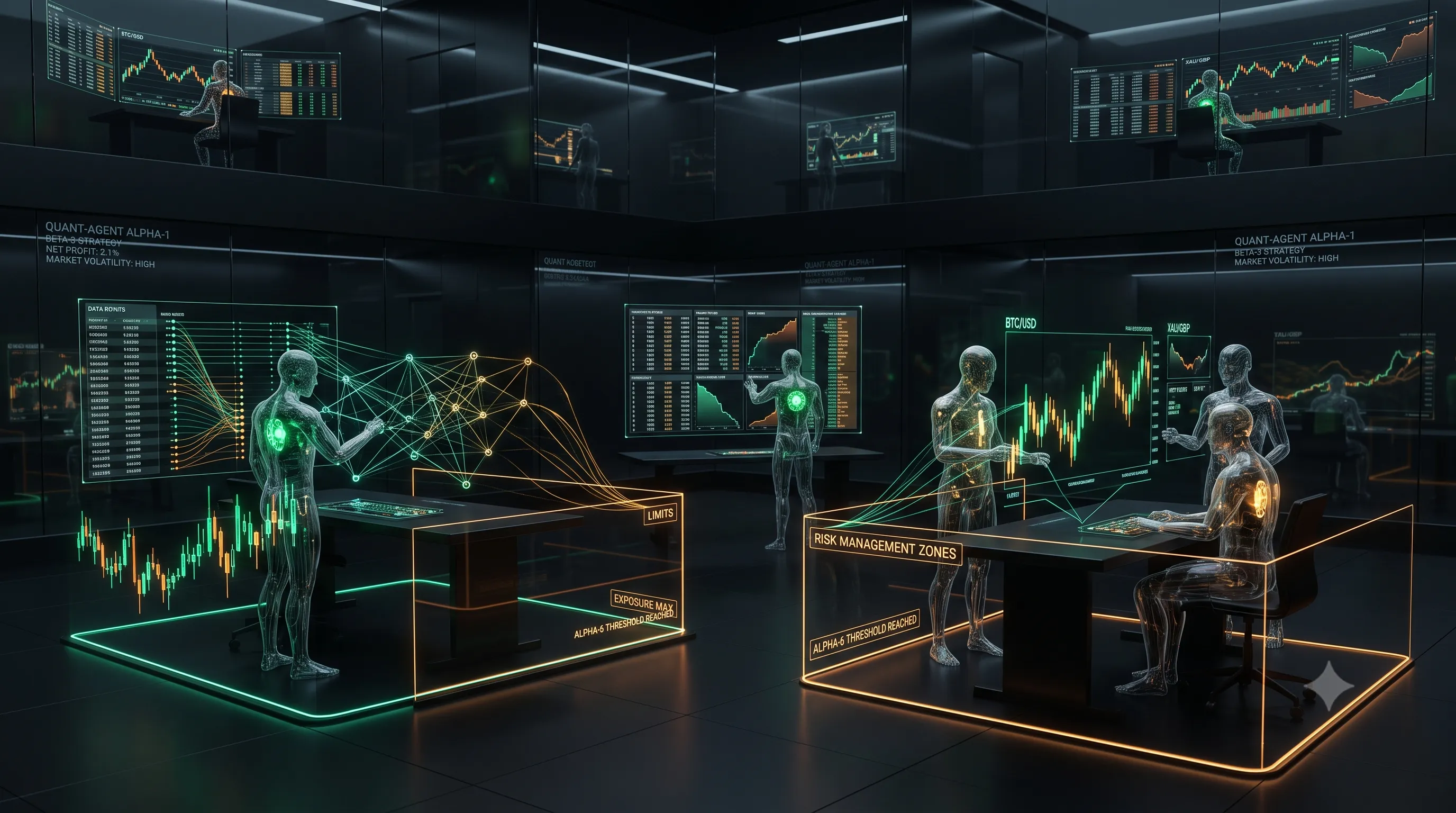
Key Developments & Executive Briefing
Collaborative Research Release
Academic ConsortiumUCLA + MITDeveloped by researchers from UCLA, MIT, and Tauric Research to systematically solve single-agent LLM financial hallucinations.
Virtual Trading Desk Simulation
Multi-Persona HierarchyRole SpecializationDeploys distinct agents for Fundamental Analysis, Technical Signals, Macro Sentiment, and an independent Risk Management Officer with veto authority.
Robust Across Market Regimes
Drawdown ResilienceSuperior Sharpe RatiosOutperformed single-agent baselines and traditional momentum benchmarks in both trending and high-volatility financial periods.
Moving Beyond Single-Prompt Financial Engineering
The application of large language models to capital markets has long been plagued by fundamental structural flaws. When financial analysts attempt to use a single monolithic LLM prompt to digest real-time order books, macroeconomic data, and company earnings reports, the model inevitably succumbs to recency bias, context saturation, and catastrophic hallucination. In high-stakes trading environments, an unconstrained language model frequently manufactures phantom regulatory filings or executes aggressive position sizing without regard for risk parity.
Addressing this architectural dilemma, a joint research team from UCLA, MIT, and Tauric Research has released TradingAgents, an open-source multi-agent LLM financial trading framework. By shifting the paradigm from solitary prompting to a decentralized multi-agent collective, TradingAgents mirrors the operational structure of an institutional quantitative investment firm.
The Institutional Virtual Trading Floor
Rather than asking a general-purpose model to act simultaneously as macro strategist, quantitative chartist, and disciplined risk officer, TradingAgents partitions the decision pipeline across discrete agent personas, each equipped with dedicated toolsets and memory buffers:
- The Fundamental Research Analyst: Ingests SEC filings (10-K, 10-Q), earnings call transcripts, press releases, and macroeconomic reports. It performs long-horizon valuation modeling and entity extraction without being distracted by intraday price fluctuations.
- The Technical Quantitative Analyst: Evaluates raw order flow, moving averages, relative strength indicators, and volatility regimes. Its sole mandate is momentum identification and entry/exit signal generation.
- The Market Sentiment Analyst: Continuously parses live news feeds, financial journalism, and social sentiment data to identify narrative velocity and retail positioning imbalances.
- The Risk Management Officer (RMO): Operating with strict fiduciary veto authority, this agent does not generate trade ideas. Instead, it evaluates proposed portfolio allocations against predefined Value-at-Risk (VaR) parameters, sector exposure caps, and liquidity constraints. If an analyst proposes an overly leveraged position, the RMO rejects or curtails the order.
- The Portfolio Execution Manager: Synthesizes the vetted debates between bullish and bearish agents, finalizes target portfolio weights, and routes execution orders.
Dialectical Debate and Hallucination Suppression
The breakthrough mechanism inside TradingAgents lies in its structured debate protocol. Before capital is allocated, opposing agent teams engage in multi-turn dialectical cross-examination. A bullish thesis formulated by the fundamental agent must survive direct counterarguments from the technical and sentiment agents, moderated by an independent synthesis layer.
This adversarial verification dramatically curbs generative hallucination. In empirical evaluations documented across historical backtests spanning bull runs, bear contractions, and black-swan volatility spikes, the multi-agent framework consistently achieved higher risk-adjusted returns (Sharpe and Sortino ratios) while experiencing substantially shallower maximum drawdowns compared to standard benchmark baselines.
Implications for Quantitative Engineering and Enterprise AI
The release of TradingAgents highlights an important shift in AI software design that extends well beyond Wall Street:
- 1.Role Specialization Beats Model Scale: A network of smaller, specialized agents governed by clear communication protocols routinely outperforms a massive single model attempting to resolve multi-variable constraints in a single pass.
- 2.Deterministic Guardrails Are Essential: The incorporation of a dedicated Risk Officer demonstrates that autonomous agentic systems cannot rely purely on probabilistic reasoning. Critical workflows require sovereign veto nodes that enforce programmatic invariants.
- 3.Decentralized Multi-Source Intelligence: By synthesizing diverse data streams—structured market ticks alongside unstructured textual reports—the architecture sets a blueprint for enterprise decision engines in insurance, supply chain logistics, and strategic corporate planning.
TradingAgents provides an open, reproducible framework that demonstrates how collaborative agent networks can conquer high-noise, adversarial domains with disciplined institutional rigor.
Fact-Checked Sources & Verified References
- TradingAgents: Multi-Agents LLM Financial Trading Framework Repository — GitHub (Tauric Research)
- TradingAgents: Multi-Agents LLM Financial Trading Framework (arXiv:2412.20138) — arXiv Computer Science & Quantitative Finance
- TradingAgents Official Project Portal & Technical Documentation — TradingAgents Consortium
Sources & References
Related Coverage
OpenArch: From-Scratch PyTorch Reference Implementations of Modern Frontier LLM Architectures
Agents & WorkflowsWhy Recursive Self-Improvement in Frontier AI Faces Hard Architectural and Mathematical Walls
Agents & WorkflowsThe Dual-Use Dilemma: Why 'AI Models Don't Kill People, People Kill People' Fails in Autonomous Cybersecurity
Discussion (0)
Be the first to share insights on this story.