Arm Unveils Mali G2-Ultra NX GPU: Bringing AI-Native Neural Graphics and DLSS-Class Rendering to Mobile
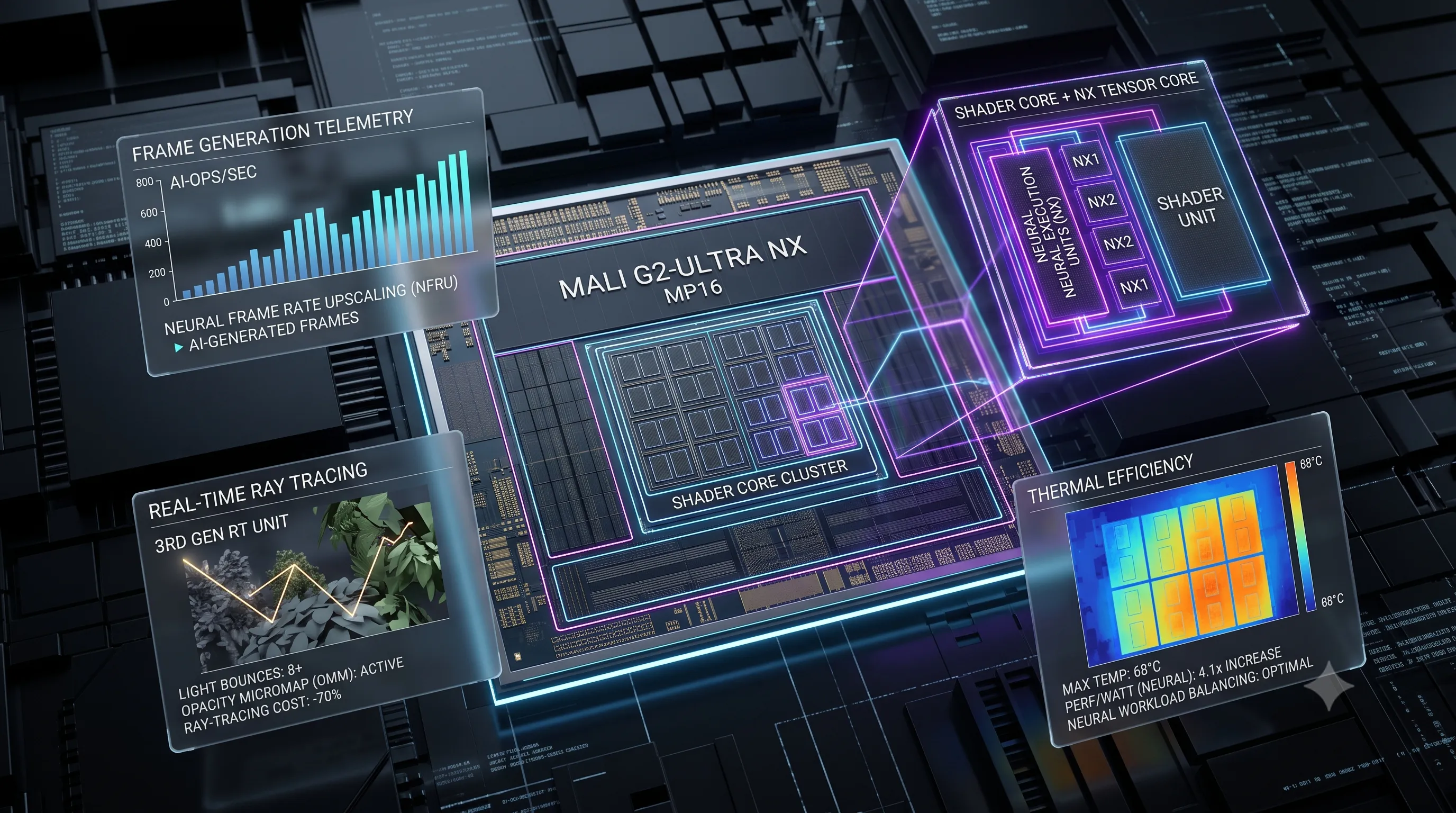
Arm has unveiled the Mali G2-Ultra NX, a flagship mobile GPU built from the silicon level for neural graphics. Featuring dedicated neural accelerators embedded directly inside shader cores, the architecture delivers up to 4x higher performance-per-watt for real-time AI upscaling, neural frame generation, and ray tracing on mobile devices.

By Ajinkya Pawar
Head of Search & AI Intelligence • The AI NEWS
Key Developments & Executive Briefing
Tightly Integrated Neural Units
In-Shader AccelerationZero Data MovementNeural execution units are fused directly into shader cores, sharing coherent L2 caches and memory systems rather than offloading to an isolated NPU.
Neural Graphics Step-Change
4x Efficiency4x Perf/WattDelivers up to a 4x efficiency leap in neural graphics pipelines, enabling continuous desktop-class rendering within standard smartphone thermal envelopes.
Full AI Upscaling & Frame Gen
Mobile DLSS PipelineGen 3 Ray TracingEnables hardware-accelerated AI super-resolution, neural frame generation, and complex ray tracing on upcoming flagship Android silicon.
The Physical Wall in Mobile Silicon
For more than a decade, the mobile graphics industry pursued performance through brute-force physical scaling: adding more shader cores, widening memory buses, and pushing silicon clock frequencies. However, in the ultra-thin form factors of modern smartphones, this brute-force paradigm has reached an unyielding thermal wall. Passive mobile cooling dissipates at most 4 to 5 watts continuously before aggressive thermal throttling collapses clock speeds and causes frame rates to stutter.
Recognizing that conventional rasterization can no longer scale within battery and thermal budgets, Arm has unveiled its next-generation flagship graphics silicon: the Mali G2-Ultra NX GPU. Introduced as part of Arm Compute Subsystems (CSS) for Mobile, the Mali G2-Ultra NX marks a philosophical pivot toward neural rendering, bringing AI-native graphics techniques pioneered on desktop workstations—such as deep learning super sampling and neural frame interpolation—directly into handheld silicon.
Fusing Neural Acceleration Inside Shader Cores
The defining architectural breakthrough of the Mali G2-Ultra NX is where and how neural computation takes place. Previously, mobile chipsets routed machine learning tasks to an isolated Neural Processing Unit (NPU) located across the system bus. While suitable for asynchronous background tasks such as voice transcription or computational photography, shuttling high-resolution render targets back and forth between the GPU and NPU incurs severe memory bandwidth penalties and latency overhead that break real-time rendering loops.
In the Mali G2-Ultra NX, Arm engineers integrated dedicated neural execution engines directly into the GPU shader cores. By collocating neural units alongside traditional arithmetic logic units (ALUs), the architecture reuses the GPU's native memory hierarchy, coherent L2 caches, and register files.
This tight coupling eliminates redundant data movement across the system-on-chip (SoC). According to Arm benchmark telemetry, this unified pipeline delivers up to a 4x improvement in performance-per-watt specifically for neural graphics workloads compared to previous-generation mobile graphics architectures.
The Desktop-Class Mobile Visual Pipeline
By embedding neural acceleration directly into the graphics pipeline alongside third-generation hardware ray-tracing units, the Mali G2-Ultra NX unlocks a suite of capabilities previously restricted to desktop graphics cards:
- Neural Super-Resolution: Games can be rendered internally at native 720p or 1080p, and then intelligently reconstructed to pristine 1440p or 4K resolution using temporal neural upscaling with minimal perceptual loss.
- Neural Frame Generation: The integrated hardware can infer and insert intermediate synthetic frames, doubling perceived smoothness from 60 FPS to 120 FPS while reducing power draw from the central CPU and primary shader cores.
- Efficient Hybrid Ray Tracing: With neural denoisers executing concurrently within the shader cluster, developers can deploy full ray-traced ambient occlusion, dynamic reflections, and soft shadows without overwhelming mobile thermal limits.
Broader Industry Impact on Mobile Computing and Agents
While mobile gaming is the most visible immediate beneficiary, the architectural implications of the Mali G2-Ultra NX extend across the broader AI ecosystem:
- 1.On-Device Multimodal Agent Interfaces: Emerging agentic user interfaces require responsive, 60+ FPS real-time rendering of spatial UI elements, local vision models, and interactive graphics. An AI-native GPU ensures that background agentic processes do not freeze the mobile display.
- 2.Democratization of Complex 3D Creation: Mobile creators can preview neural radiance fields (NeRFs), Gaussian splatting, and real-time diffusion textures natively on handheld devices without relying on tethered cloud servers.
- 3.Closing the Mobile-Desktop Fidelity Chasm: With major silicon partners preparing implementations for next-generation flagship Android devices, the boundary between desktop console visual fidelity and pocket computing continues to dissolve.
Arm's Mali G2-Ultra NX signals that the future of mobile visual computing will not be measured merely in raw teraflops, but in the efficiency of intelligent neural reconstruction.
Fact-Checked Sources & Verified References
- Inside the Arm Mali G2-Ultra NX GPU: Delivering desktop-class mobile gameplay with AI-native graphics — Arm Newsroom Blog
- Arm introduces new AI-native compute platform built for agentic AI and mobile graphics — Arm Newsroom Press Release
- Arm Mali G2-Ultra NX brings DLSS-style graphics to Android — TBreak Tech
Sources & References
Related Coverage
OpenArch: From-Scratch PyTorch Reference Implementations of Modern Frontier LLM Architectures
Agents & WorkflowsWhy Recursive Self-Improvement in Frontier AI Faces Hard Architectural and Mathematical Walls
Agents & WorkflowsThe Dual-Use Dilemma: Why 'AI Models Don't Kill People, People Kill People' Fails in Autonomous Cybersecurity
Discussion (0)
Be the first to share insights on this story.